Frendo
Clown in a CornfieldFrendo is Kettle Springs’ clown mascot: a recognizable local image that shifts from a soot-blackened factory mural to a prank-video prop and, finally, the appearance of a violent assailant. The clown’s fixed costume and battered likeness make him easy to recognize, but the scenes attached to that image grow steadily less playful. Frendo’s significance lies in that reversal: the town tries to make its mascot more homicidal as a joke, while a figure dressed as Frendo carries out a real, brutal attack.
Mascot and Image
Quinn Maybrook first sees Frendo painted on the side of the burned Baypen factory. From a distance, the image looks like one of Philadelphia’s familiar murals, but the building’s wall has been blackened by the calamity that ruined it. When Quinn uses her phone to zoom in, the clown’s features emerge through the damage: a porkpie hat, bulbous red nose, faded greasepaint stubble, and a once-white face now gone gray. The paint on the nose has blistered, yet the eyes remain comparatively untouched by the flames. Their fixed direction makes the painted figure seem to stare straight at Quinn’s window.
That first encounter establishes Frendo as more than cheerful decoration. His image is already bound to a burned industrial building, and the surviving eyes give the mural a disturbing persistence: the factory has been damaged, the paint has deteriorated, but the gaze remains. Quinn does not yet know the clown’s name or what he means to the town. She recognizes the face later, after seeing it reproduced elsewhere.
A Town-Made Reinvention
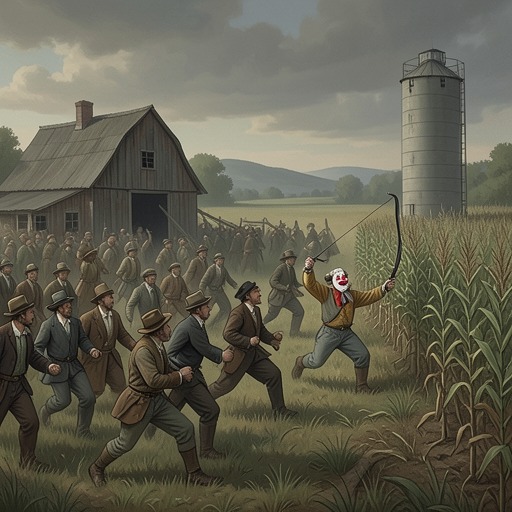
In a cached collection of videos on Tucker Lee’s phone, Quinn finds a clip titled “KILLER CLOWN—HAUNTED BARN STUNT TrY Not to LauGH :-D”. Its thumbnail shows a clown in a porkpie hat carrying an oversized plastic sickle and sliding out from behind a barn door. Quinn recognizes the hat and connects the video figure to the clown she has seen around town. Cole Hill explains that the town loves Frendo as its mascot, but that he and his friends consider the character lame. They have been trying to give him a makeover and rehabilitate his image by making him more homicidal.
The makeover turns Frendo into a joke about violence: the plastic sickle, haunted-barn setting, and deliberately exaggerated video title present menace as staged entertainment. Yet Quinn’s recognition links that online persona to a physical presence in Kettle Springs. Frendo is at once a civic mascot and a character the younger residents treat as material for a violent parody. The gap between the harmlessness implied by a mascot and the group’s chosen homicidal makeover becomes increasingly uncomfortable as the clown appears outside the videos.
The Clown in the Street
Quinn’s next encounter is not with an image on a wall or a figure on a screen. An angry, honking sound approaches, and she jumps aside just before a massive clown on a tiny bicycle nearly runs her over. She recognizes him as the same Frendo who seemed to watch her from the burned Baypen factory. The rider speeds between pedestrians, with pom-poms dangling from the handlebars and a squeeze-horn adding comic noise to the near collision.
The encounter combines a threateningly large rider with deliberately ridiculous equipment. The tiny bicycle, pom-poms, and honking horn make the appearance look like street theater, but Quinn has to get out of the way to avoid being struck. Frendo’s movement through a public crowd also changes the nature of the image: what had watched from a wall now occupies the same space as pedestrians, moving quickly enough to startle and endanger them. Quinn calls after him to watch where he is going, treating the incident as reckless behavior rather than a performance she has agreed to join.
Costume and Violence
A later attack on Harlan Jaffers gives Frendo’s visual identity a much darker association. As Harlan leaves a meeting, a reflection in the wet asphalt catches his attention: a silver-and-red swoosh, white greasepaint, and a beard smudged like cigar ash. The familiar colors lead him to turn toward someone dressed as Frendo. He has no time to become afraid before the attacker strikes with an ice pick.
The weapon misses Harlan’s temple, where the clown had been aiming, and enters the side of his neck, stopping only after nicking a vertebra. Harlan drops to his knees in a puddle as the attacker drives the ice pick farther in, up to its handle. The wound leaves him unable to scream; he lies on the pavement, gurgling for two minutes before blood loss renders him unconscious. The scene establishes the figure in Frendo’s costume as a serious assailant, but it does not by itself establish who is inside the costume or confirm Harlan’s eventual fate.
Across these appearances, Frendo’s meaning changes without losing its recognizable markers. The porkpie hat and painted face connect a scorched mural, an intentionally silly video, a bicycle-riding clown, and an attack in a wet parking lot. That continuity makes the costume an effective disguise and a source of dread: the town’s mascot can be copied for a joke, but its familiar appearance also accompanies violence that is not staged. The surviving evidence leaves Frendo’s wearer unidentified, keeping the clown’s public image distinct from the person who uses it to attack.